Collection Item
Dunmore Letter
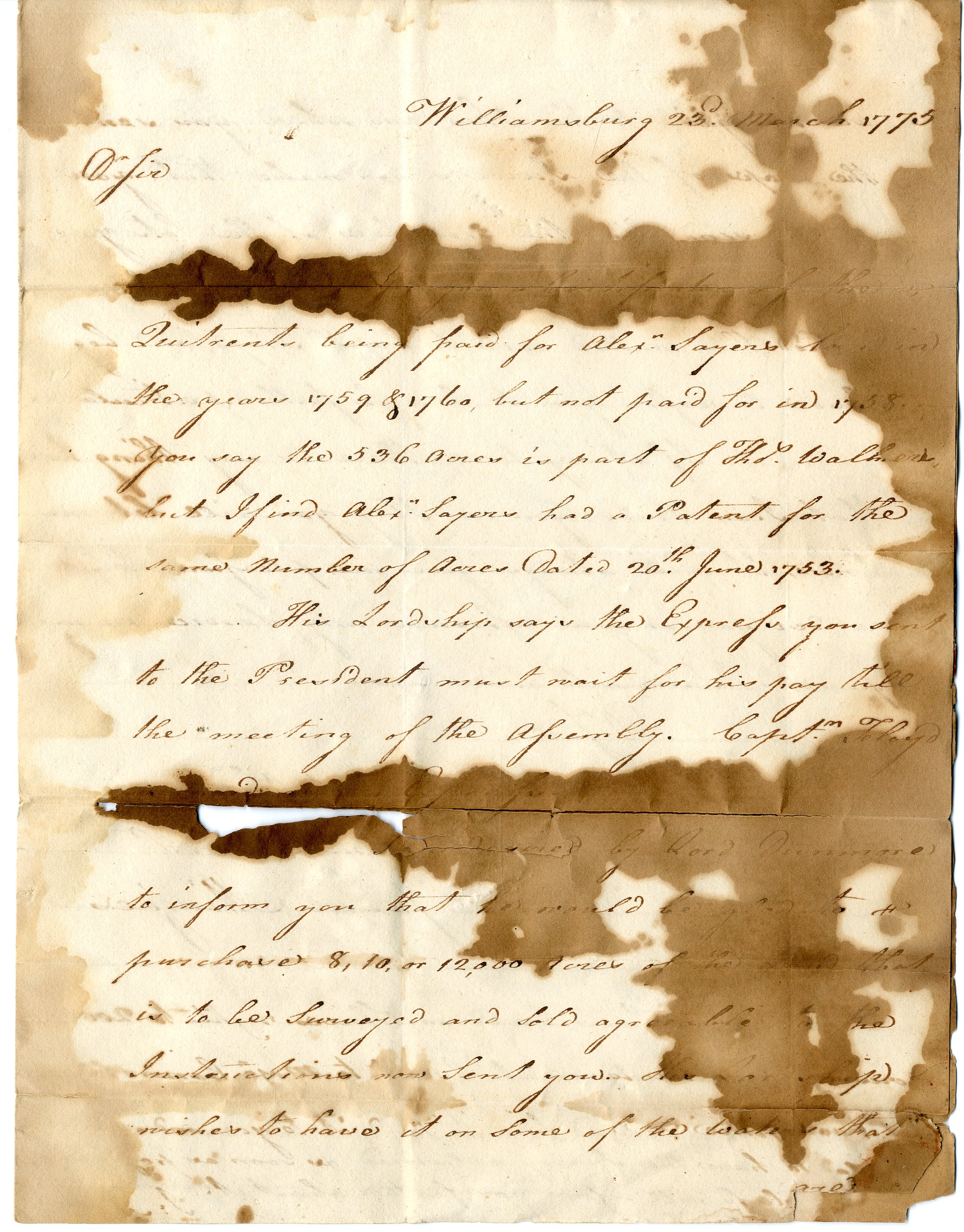
This 1775 letter, written on behalf of Royal Governor Lord Dunmore by his secretary James Minzies, requests that Colonel William Preston—one of the signers of the Fincastle Resolutions—survey land to sell on behalf of King George III. Remarkably, it was written the very same day Patrick Henry delivered his impassioned “Give Me Liberty, or Give Me Death” speech in Richmond. The letter reflects Lord Dunmore’s attempt to maintain royal authority and neutrality amid growing revolutionary tensions, yet its contents provoked a strong response from Virginia patriots. Patrick Henry and Thomas Jefferson declared that the King had “no right to grant lands of himself,” a sentiment that further solidified Virginians’ resolve for independence.
More background information:
Col. William Preston (1729-1783) was both a signer of the Fincastle Resolutions in January of 1775 and a member of the Fincastle Committee of Safety – one of the many local grassroots patriot organizations opposing British authority. Preston lived in present-day Blacksburg, Montgomery County, and acted as surveyor, member of the House of Burgesses, and was an officer in both the French & Indian War and in Lord Dunmore’s War.
James Minzies (1740 – 1815) was the personal secretary of Lord Dunmore, and the Auditor of Accounts of his accounts. Lord Dunmore, or John Murray, was the last colonial governor of the state of Virginia, succeeded in 1770 after the death of Lord Botetourt. Lord Dunmore is most well-known for his campaigns against the Native Americans on the western side of the colony, invoking Lord Dunmore’s War in October 1774. He issued Dunmore’s Proclamation in November of 1775, offering freedom for Virginia’s enslaved populations if they fled and joined the British army against the patriot colonists. Dunmore fled Virginia in 1776, eventually returning to London.
In this letter, Dunmore asked Preston to survey tracts of land up to 12,000 acres to sell on behalf of King George III, referencing the King’s decree to survey and sell lands west of the Appalachian Mountains to the highest bidder – land previously outside the arbitrary line on which colonists could settle under the Proclamation of 1763 after the French & Indian War. This land was acquired by the colony of Virginia after the Shawnee defeat in Lord Dunmore’s War in October of 1774. With growing patriot sentiments, Botetourt and Fincastle Counties both signed Resolutions against the actions taken by the crown. Shortly after the Fincastle Resolutions, freeholders in Fincastle County elected William Preston, along with others also present in Lord Dunmore’s War to become the first iteration of Fincastle’s Committee of Safety – the first on the western side of the state, firmly placing Preston on the side of the growing patriotic movement.
This letter signifies Lord Dunmore's attempt at neutrality in the looming conflict, but its contents unintentionally spurred Patrick Henry and Thomas Jefferson's response that the King had "no right to grant lands of himself," further solidifying Virginians in their patriotism and freedom from Great Britain. As a result of Dunmore's instructions, a formal Resolution from the Fincastle Committee of Safety dated September 6, 1775, also in the Historical Society of Western Virginia's collection, resolves that Col. William Preston, promised the Fincastle Committee of Safety that "no lands should be surveyed agreeable to said instructions...under warrants from the Governor...[and that his officers] should desist from surveying under the aforesaid Instructions." That document continues, "Col. Preston has acted consistent with the above promise ever since," and confirmed that he sent a petition to the Convention containing his disagreement to Dunmore's orders.” At this point, Col. William Preston declared his patriotism with the Fincastle Committee of Safety finding no fault in his actions to take orders from the Governor.
Discover the Stories That Shaped Western Virginia
From iconic photographs and historic artifacts to exhibitions, events, and educational programs, there’s always something waiting to be discovered.